
Chain Pitch vs Gauge Explained
If you’ve recently bought a mini chainsaw, you’ve probably encountered terms like chain pitch and gauge.
At first glance, they sound technical and a bit intimidating, but they’re actually quite simple once you break them down.
Understanding these two concepts will help you choose the right chain, maintain your saw properly, and cut more efficiently.
Let’s make it easy.
What Is Chain Pitch?
Chain pitch refers to the distance between the links in your chainsaw chain.
More specifically, it’s half the distance between any three consecutive rivets (the small metal pins holding the chain together).
In practical terms, pitch determines how big and aggressive the cutting teeth are.
- Smaller pitch (e.g., 1/4″) = smoother, lighter cutting
- Larger pitch (e.g., 3/8″) = faster, more aggressive cutting
Most mini chainsaws use a small pitch, typically 1/4″ or 3/8″ low-profile.
This is because mini chainsaws are designed for lighter tasks like pruning, trimming, and cutting small branches and not heavy-duty work like logging.
Why it’s important:
Using the wrong pitch means the chain won’t fit your saw’s sprocket (the rotating gear), and your chainsaw simply won’t work properly.
What Is Chain Gauge?
Gauge refers to the thickness of the chain’s drive links. That’s the part of the chain that sits inside the guide bar groove.
Think of it like this:
– The guide bar has a groove
– The chain slides inside that groove
-The gauge must match the groove width exactly
Common mini chainsaw gauges include:
0.043″ (narrow, lightweight)
0.050″ (slightly thicker, more durable)
Why it matters:
If the gauge is too thin, the chain will wobble and cut poorly. However, if it’s too thick, it won’t fit into the bar at all.
Why Pitch and Gauge Must Match Your Chainsaw
Your mini chainsaw is designed to work with specific chain dimensions.
Pitch and gauge are not interchangeable or flexible. You must match exactly what your saw requires.
Using the wrong combination can lead to:
– Poor cutting performance
– Increased wear on the motor
– Safety risks like chain derailment
The easiest way to get it right?
Check your chainsaw manual or look at the markings on the guide bar which usually list the correct pitch and gauge.
A Simple Way to Remember
- Pitch = size of the chain teeth (cutting feel)
- Gauge = thickness of the chain (fit in the bar)
If pitch is about how it cuts, gauge is about how it fits.
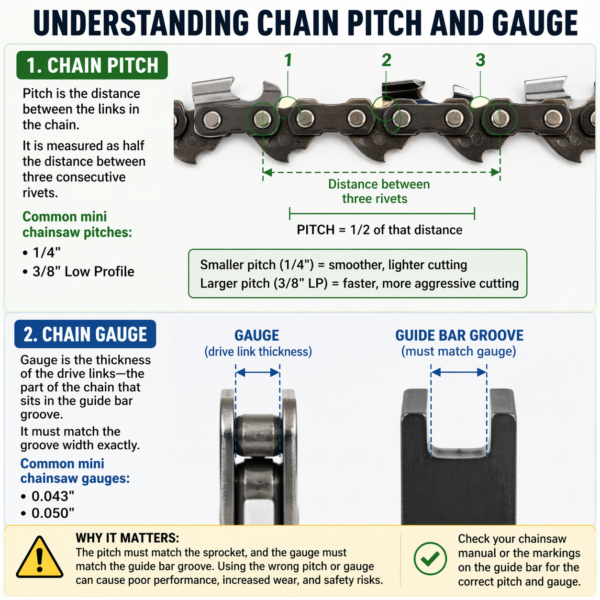
Understanding chain pitch and gauge might seem like a small detail, but it makes a big difference in how your mini chainsaw performs.
When you use the correct chain, your saw cuts smoother, lasts longer, and stays safer to operate.
As a new chainsaw owner, getting these basics right will save you time, money, and frustration and will help you get the most out of your mini chainsaw from day one.